






Apple has officially unveiled iPhone Duo, its first foldable iPhone, ending years of speculation over whether the device would be called the iPhone Fold or iPhone Ultra.
It opens to a 7.6-inch inner display and closes to a 5.4-inch outer display, runs on the new A20 Pro chip, and starts at $1,999 for 256GB. Pre-orders open October 16, 2026, with the phone shipping October 23.
It uses Touch ID instead of Face ID, skips a telephoto camera, and ships with iOS 27.1.
What Is the iPhone Duo?
For nearly two years, Apple Headlines and the rest of the Apple rumor mill argued over three names for this device: iPhone Fold, iPhone Ultra, and iPhone Duo.
Bloomberg’s Mark Gurman reported that Apple employees called it the Ultra internally.
Other leakers insisted Fold made more sense.
As of September 9, 2026, that debate is over. Apple’s new CEO, John Ternus, took the stage at the company’s “Surprise and Shine” event, his first keynote since replacing Tim Cook on September 1, and introduced the device as iPhone Duo.
The name references the phone’s two screens rather than its size or power, which is why Apple skipped the Ultra branding it already uses for Apple Watch Ultra and its M-series chips.
Ternus used his keynote to draw a contrast with rival foldables, saying other companies’ folding phones feel like two phones stuck together, while iPhone Duo is built around one continuous frame and one continuous piece of software.
iPhone Duo is not a replacement for the iPhone 18 Pro Max.
It is a new, third category that sits above the Pro line on price and below it on camera hardware, aimed at buyers who want the biggest possible iPhone screen and are willing to trade away Face ID and a telephoto lens to get it.
iPhone Duo Price and Storage Options
iPhone Duo comes in four storage tiers, though Apple has only confirmed pricing for the base model so far.
Expect the remaining tiers to be listed when pre-orders open.
| Storage | Price |
|---|---|
| 256GB | Buy from $1999or $83.29/mo. per month for 24 mo.months Lease from $57.99/mo. per monthfor 24 mo.months |
| 512GB | Buy from $2199or $91.62/mo. per month for 24 mo.months Lease from $63.80/mo. per monthfor 24 mo.months |
| 1TB | Buy from $2599or $108.29/mo. per month for 24 mo.months Lease from $75.40/mo. per monthfor 24 mo.months |
| 2TB | Buy from $3199or $133.29/mo. per month for 24 mo.months Lease from $92.81/mo. per monthfor 24 mo.months |
That starting price puts iPhone Duo $700 above the iPhone 18 Pro Max ($1,299) and $800 above the iPhone 18 Pro ($1,199).
Apple also offers it through its Apple Upgrade leasing program starting at $57.99 a month over 24 months, which spreads the cost out but locks buyers into a two-year term.
For context, iPhone Duo lists at roughly $100 more than Samsung’s standard Galaxy Z Fold 8 at matching storage tiers, though it undercuts the larger Z Fold 8 Ultra.
The box includes only the iPhone Duo and a 1-meter USB-C cable.
There is no charging adapter, and Apple’s official accessories add extra cost: the iPhone Duo Case runs $79, and the Duo Folio with a built-in kickstand is $129.
iPhone Duo Release Date
- Pre-orders open: Friday, October 16, 2026, at 5:00 a.m. PT
- On sale: Friday, October 23, 2026
- Availability: More than 70 countries at launch
- Software: Ships running iOS 27.1
That’s about five weeks after the iPhone 18 Pro and Pro Max, which ship September 18.
Anyone comparing the two side by side at launch will have to wait for the Duo separately.
Design and Durability
iPhone Duo folds like a book rather than a clamshell, closer in concept to the Galaxy Z Fold 8 than to a flip phone.
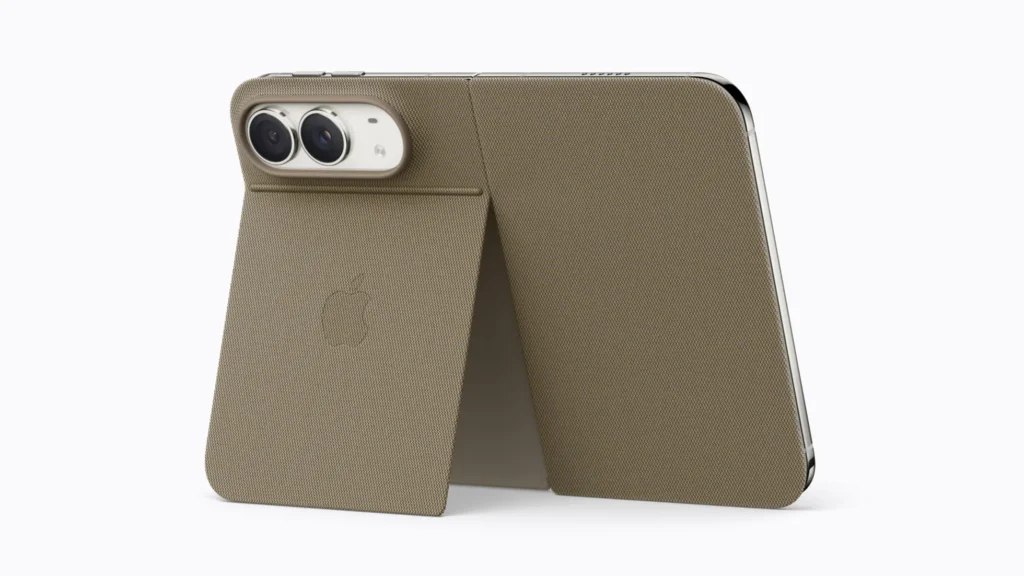
Apple built the frame and hinge cover from grade 5 titanium, with Ceramic Shield 2 on the front and standard Ceramic Shield on the back.
The hinge itself uses more than 100 small precision components to keep the inner display flat when open and to control the folding motion.
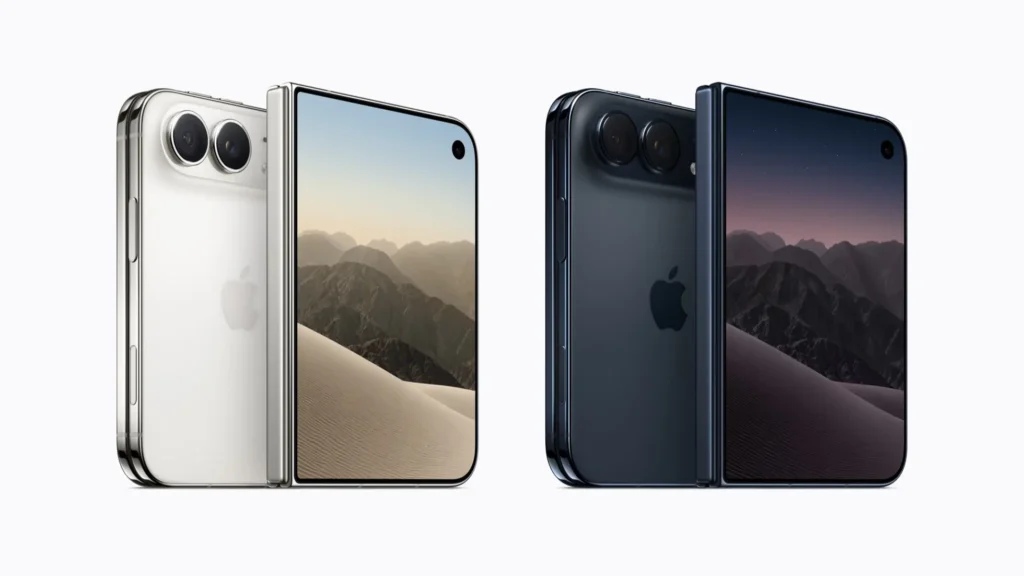
Two colors are available at launch: Star White and Night Sky.
Apple has not published exact weight or dimension figures at the time of writing, though hands-on impressions describe it as noticeably lighter than the Galaxy Z Fold 8, which weighs 53 grams more.
iPhone Duo carries an IP68 water and dust resistance rating, ahead of the Z Fold 8’s IP48 rating.
There is no physical SIM tray in any country; iPhone Duo is eSIM-only worldwide.
Touch ID replaces Face ID here, built into the side button rather than the display.
The phone can also be unlocked using a paired Apple Watch.
Displays
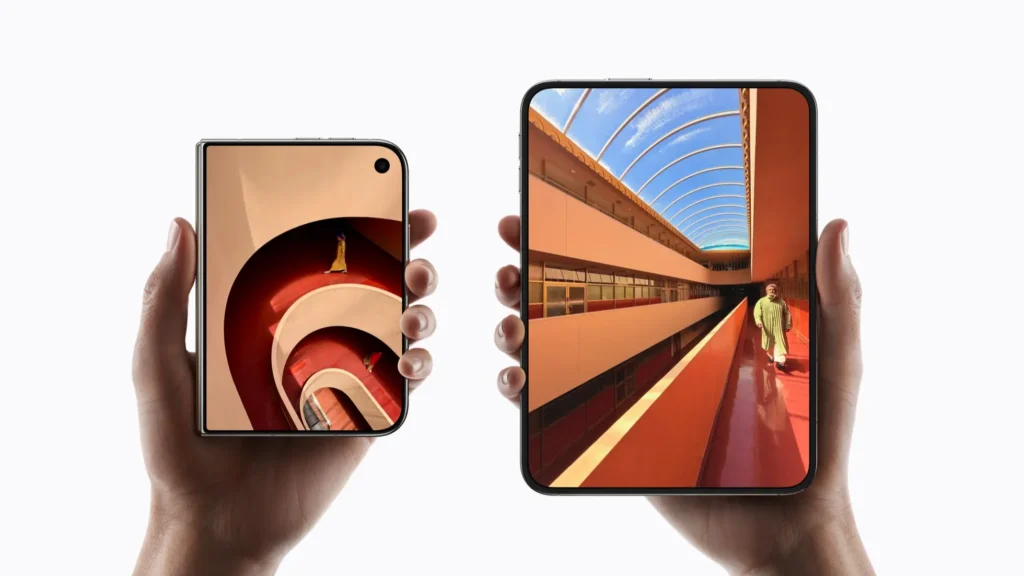
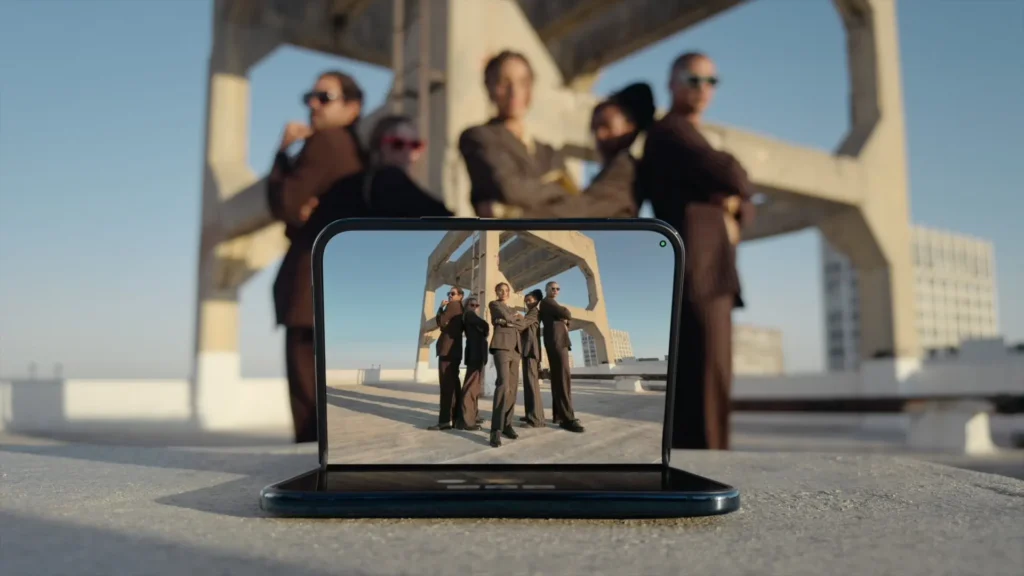
iPhone Duo’s headline feature is its screen. Both panels share the same aspect ratio, so content resizes cleanly when you open or close the phone instead of getting cropped or stretched.
- Inner display: 7.6-inch Super Retina XDR, described by Apple as the largest and thinnest iPhone display ever, roughly 50% larger than the iPhone 18 Pro Max screen
- Outer display: 5.4-inch Super Retina XDR, about 90% of the screen area of a standard iPhone 18 Pro
- Shared features: ProMotion, Always-On display, Dynamic Island
Apple also detailed two display technologies aimed at the biggest weakness of every foldable phone: the visible crease.
A custom nano-texture finish cuts down glare and reflections, and a separate micro-lens texture, produced through what Apple calls maskless laser lithography, is meant to make the fold line far less noticeable while keeping the surface feeling smooth to the touch.
Software adjusts as the phone opens. Controls sit within thumb’s reach along the sides of the display, the Home Screen dock switches to a vertical layout, and the status bar tucks into the display’s corner instead of running across the top.
Performance: A20 Pro Chip
iPhone Duo runs on the new A20 Pro, Apple’s first chip built on a 2-nanometer process, also used in the iPhone 18 Pro and Pro Max.
It has a 6-core CPU that Apple says is up to 20% faster than the A19 Pro, a 7-core GPU with Neural Accelerators, and a dual 16-core Neural Engine to handle on-device Apple Intelligence tasks.
Because it shares silicon with the Pro line, iPhone Duo is not a step down in raw speed. The difference between it and the Pro models comes down to the body and the camera system built around that chip, not the chip itself.
Pro Tip: If you’re deciding between iPhone Duo and an iPhone 18 Pro Max, don’t frame it as a performance decision — both use the same A20 Pro. Frame it as a camera-versus-screen trade-off instead: the Pro Max keeps the telephoto lens and Face ID, while the Duo trades both away for a screen more than double the size when open. Pick based on which one you’d actually miss.
iPhone Duo Camera System
iPhone Duo uses a 48MP Dual Fusion rear camera system:
- 48MP Main, 26mm, f/1.6
- 48MP Ultra Wide, 13mm, f/2.2
- No telephoto lens — zoom tops out at 4x optical-quality zoom range and 10x digital
- No variable aperture, unlike the iPhone 18 Pro
The front camera is a 12MP Center Stage sensor hidden under the inner display, which appears only when you open the Camera or FaceTime app.
Video tops out at 4K at 120fps in Dolby Vision on the main camera, with Cinematic effects applied after shooting and 4K time-lapse support in Dolby Vision HDR.
Four camera and display features exist only on iPhone Duo, built around the fact that the outer screen can face the same direction as the rear cameras:
- Smart Take — automatically captures a photo when everyone in frame is posed and ready
- Duo Preview — shows subjects a live preview on the outer display while you shoot
- Kid Cue — plays short animations on the outer display to get children’s attention during a photo
- Duo FaceTime — lets someone standing nearby join a FaceTime call using the outer display
These features are the clearest reason to choose Duo over a Pro Max if photography matters to you, even without a telephoto lens.

Battery and Charging
iPhone Duo runs on two batteries, one built into each half of the phone, which Apple says operate together as a single power source rather than two separate cells.
Apple’s official battery ratings:
- Up to 44 hours of video playback using the outer display only
- Up to 31 hours of video playback using the inner display
- Up to 24 hours of typical mixed daily use, split across both screens
Apple has not published battery capacity in mAh for either cell. Unconfirmed early estimates put the combined capacity between 5,000mAh and 5,500mAh, but treat that as a placeholder until Apple or a teardown confirms it.
Charging details:
- A 60W USB-C adapter reaches 50% in about 20 minutes
- A 35W adapter with MagSafe takes about 30 minutes to the same point
- MagSafe and Qi2 wireless charging both top out at 25W
- No power adapter is included in the box
Software and iOS 27
iPhone Duo ships with iOS 27.1, which Apple describes as reimagined for the fold rather than simply stretched across a bigger screen.
The system is designed to transition smoothly between the outer and inner displays as you open the phone, keeping controls in a consistent position while content adapts around them.
Apple Pencil (USB-C) support is coming to iPhone Duo later in 2026, though the Pencil itself is sold separately and was not bundled at launch.
Combined with the 7.6-inch inner display, that positions iPhone Duo as a note-taking and sketching device as much as a phone, for anyone who wants that use case.
Apple Intelligence and the new Siri AI features run on-device using roughly 7GB of storage for the models, which Apple notes can be removed if you don’t use them.
A standard iOS 27 configuration otherwise takes up approximately 12GB to 24GB, including deletable Apple apps — worth knowing before you decide how much storage to actually buy.
Case Study: Choosing Between Duo and Pro Max
One reader who wrote in ahead of this year’s event described a familiar dilemma: two years into an iPhone 17 Pro Max, due for an upgrade, and torn between the safe choice and the new one.
His deciding factors ended up being the same three things most buyers will weigh.
First, he rarely used the 5x telephoto zoom on his current phone, which made losing it on the Duo feel like a smaller loss than expected.
Second, he already reads and edits documents on his phone daily, and the idea of a 7.6-inch screen replacing a separate tablet for that task was worth real money to him.
Third, Face ID’s absence gave him pause, since Touch ID via the side button is a workflow he hasn’t used since an iPhone SE years earlier.
His plan, shared with us, was to wait for hands-on reviews after the October 23 release before finalizing the order — a reasonable approach given how many specifics Apple left unconfirmed at announcement.
iPhone Duo vs iPhone 18 Pro Max
| iPhone Duo | iPhone 18 Pro Max | |
|---|---|---|
| Starting price | $1,999 (256GB) | $1,299 (256GB) |
| Main display | 7.6-inch inner / 5.4-inch outer | Single display |
| Chip | A20 Pro | A20 Pro |
| Rear cameras | 48MP Main + 48MP Ultra Wide | 48MP Main + Ultra Wide + Telephoto |
| Optical-quality zoom | Up to 4x | 5x telephoto |
| Face ID | No (Touch ID in side button) | Yes |
| Water resistance | IP68 | IP68 |
| SIM | eSIM only | eSIM (US) |
| Ships | October 23, 2026 | September 18, 2026 |
The two run identical silicon, so this comparison mostly comes down to screen size and shape versus camera reach and Face ID.
Apple positions the Pro Max as the camera-first flagship and the Duo as the screen-first flagship, not as a straight upgrade path from one to the other.
iPhone Duo vs Samsung Galaxy Z Fold 8
| iPhone Duo | Galaxy Z Fold 8 | |
|---|---|---|
| Starting price | $1,999 | Roughly $100 less at matching storage |
| Water resistance | IP68 | IP48 |
| Build | Grade 5 titanium | Aluminum frame |
| Rear cameras | 2 (no telephoto) | Up to 3, including telephoto on some tiers |
| Software update commitment | Not yet specified by Apple | 7 years of OS and security updates (Samsung) |
| Unique features | Smart Take, Duo Preview, Kid Cue, Duo FaceTime | Broader Android app/tablet-mode ecosystem |
Samsung’s stronger point is its stated seven-year update commitment, which Apple has not matched with a specific number for iPhone Duo, even though iPhones have historically received six or more years of software support.
Apple’s stronger points are water resistance, build material, and the fold-aware camera features unique to Duo.
Common Concerns Before You Buy
Is 256GB enough storage?
For a phone built around a 7.6-inch display, 4K 120fps video, and dual 48MP cameras, 256GB fills up faster than it would on a standard iPhone.
If you plan to use the inner display as a document or sketching surface with Apple Pencil, 512GB is the safer starting point once Apple prices it.
Will the crease be visible?
Apple’s nano-texture and micro-lens display technology is built specifically to reduce this, but no outlet has done extended hands-on testing yet.
Treat any pre-review claims about crease visibility as unverified until independent reviewers get units in late September or October.
Is losing Face ID a dealbreaker?
It depends entirely on habit. Anyone who has used Touch ID on an iPad or Mac with Touch ID adjusts quickly.
Anyone deep into Face ID-dependent workflows, like Face ID-gated banking apps that haven’t been tested on Duo yet, should wait for compatibility confirmation before switching.
Does the missing telephoto lens matter?
Only if you regularly shoot at 5x zoom or beyond on a current Pro model. The Duo’s 4x optical-quality range covers most everyday zoom use but won’t match a dedicated telephoto lens for distant subjects.
Key Takeaways
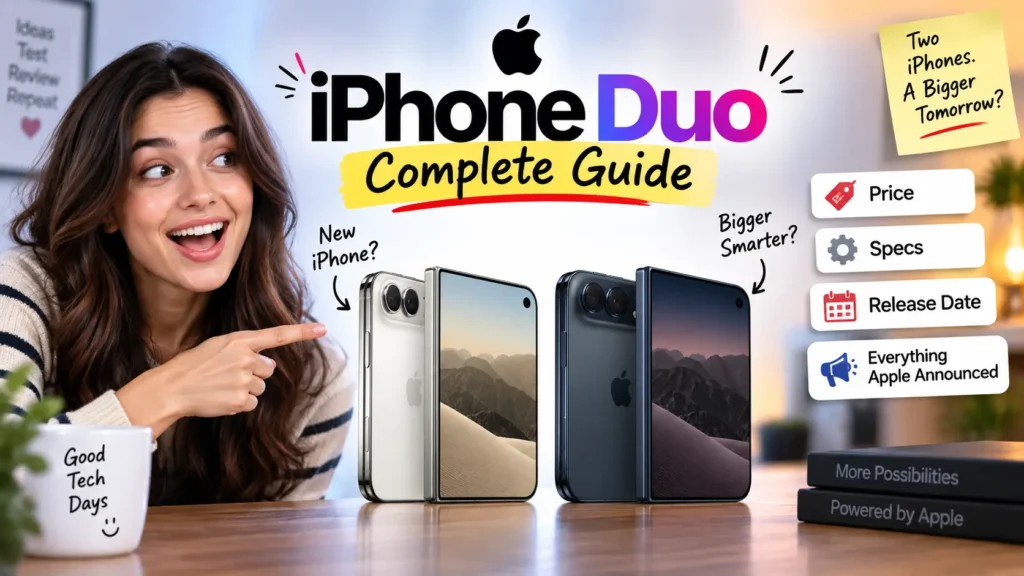
- iPhone Duo is Apple’s first foldable iPhone, officially named at the September 9, 2026 “Surprise and Shine” event, resolving years of iPhone Fold and iPhone Ultra naming rumors.
- Starting price is $1,999 for 256GB, rising to $3,199 for 2TB; mid-tier pricing is still unconfirmed.
- Pre-orders open October 16, 2026; the phone ships October 23, 2026, five weeks after the iPhone 18 Pro line.
- It runs the same A20 Pro chip as the iPhone 18 Pro and Pro Max, so the real trade-off is camera and Face ID versus screen size, not speed.
- Exclusive fold-aware camera features — Smart Take, Duo Preview, Kid Cue, and Duo FaceTime — use the outer display in ways no other iPhone can.
- Battery capacity in mAh, mid-tier pricing, exact weight, and a software support timeline remain unconfirmed by Apple as of publication.
FAQ
Yes. Duo is the official name Apple gave the device that had been referred to as iPhone Fold and iPhone Ultra throughout 2025 and 2026 rumors.
$1,999 for 256GB, up to $3,199 for 2TB. Apple has not yet published pricing for the 512GB and 1TB tiers.
Pre-orders start October 16, 2026, at 5 a.m. PT. It goes on sale October 23, 2026.
No. It uses Touch ID built into the side button instead, and it can also be unlocked with a paired Apple Watch.
Yes, Apple Pencil (USB-C) support is coming later in 2026. The Pencil is sold separately.
7.6 inches when open, 5.4 inches on the outer display when closed.
The A20 Pro, the same chip in the iPhone 18 Pro and iPhone 18 Pro Max.
No. It has two 48MP rear cameras — Main and Ultra Wide — with up to 4x optical-quality zoom and no dedicated telephoto lens.
Sources
- Apple Newsroom, iPhone Duo announcement, September 9, 2026
- Apple.com, iPhone Duo product and tech specs pages
Disclaimer: iPhone Duo pricing, specifications, and availability are based on Apple’s official announcement as of September 10, 2026. Several details – including mid-tier storage pricing, exact weight and dimensions, and battery capacity – had not been published by Apple at the time of writing and will be updated once confirmed. This article is not sponsored by Apple.
More Read

T’kal is the lead strategist and developer behind Apple Headlines. With a background in digital marketing and web development, he specializes in technical Apple troubleshooting, software news, and hardware rumors. T’kal focuses on delivering high-authority tech content that bridges the gap between Apple enthusiasts and the latest industry innovations.